
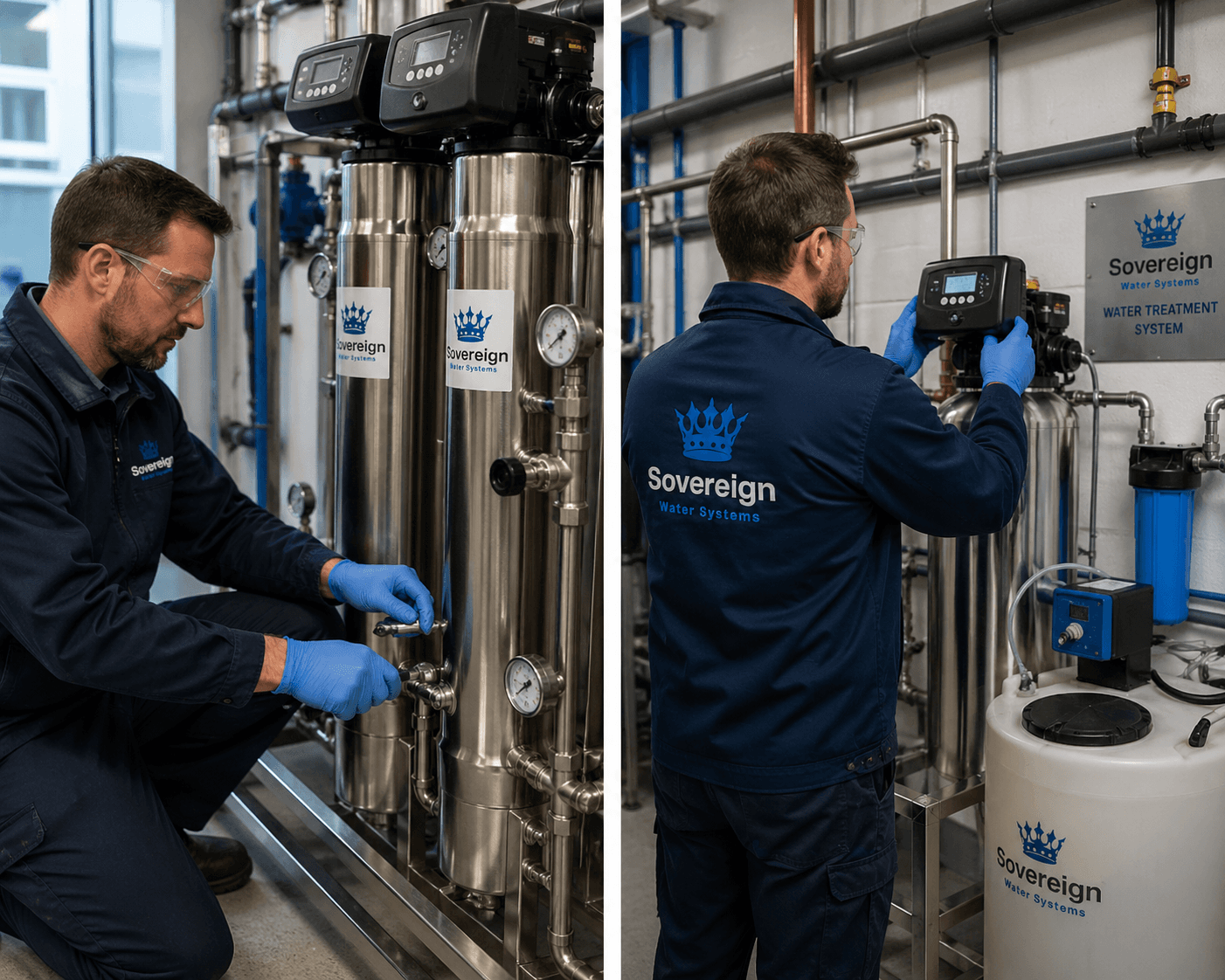
A water treatment maintenance schedule Saudi Arabia facilities managers and building operators implement is the single most effective tool for protecting commercial water systems against the unique challenges of the Kingdom’s water supply conditions, extreme ambient temperatures, and the operational demands of high-performance commercial properties. Without a structured programme, water treatment systems degrade silently: filters exceed capacity, softener resin becomes exhausted, chemical dosing pumps lose calibration, and the conditions that allow Legionella and other biological risks to develop go undetected. At Sovereign Water, our Comprehensive Maintenance programme is built around proactive, scheduled care that prevents these failures before they occur.
Saudi Arabia’s commercial water environment presents specific challenges that make a rigorous maintenance schedule more important, not less, than in more temperate climates. Desalinated mains water, high Total Dissolved Solids (TDS) in some regions, ambient temperatures regularly exceeding 45°C in summer, and the complex water systems of large commercial, hospitality, and healthcare facilities all demand a maintenance approach that is structured, documented, and professionally managed. This guide covers everything facilities managers in the Kingdom need to know.
TL;DR
- A structured water treatment maintenance schedule catches failing filters, exhausted resin and drifting dosing pumps before they cause unplanned downtime.
- Saudi Arabia’s extreme ambient temperatures make cold water temperature control and Legionella monitoring significantly more demanding than in temperate climates.
- Chemical dosing systems require daily verification, monthly calibration, and quarterly pump overhauls to ensure consistent treatment of desalinated and high-TDS water supplies.
- Periodic system disinfection and microbiological sampling, set by a site-specific risk assessment, are part of international best practice for commercial buildings.
- Sovereign Water provides fully managed Comprehensive Maintenance contracts for commercial water treatment systems across Saudi Arabia, including site assessments.
In This Article
- Why a Water Treatment Maintenance Schedule Matters in Saudi Arabia
- What to Include in Your Commercial Schedule
- Frequency Breakdown: Daily to Annual Tasks
- Chemical Dosing: Maintenance, Calibration and Compliance
- Annual System Line Disinfection and Testing
- Legionella Monitoring, Sampling and International Best Practice
- Comprehensive Maintenance vs Reactive Maintenance
- How to Build Your Water Treatment Maintenance Schedule
- How Sovereign Water’s Comprehensive Maintenance Works in KSA
- Frequently Asked Questions
Why a Water Treatment Maintenance Schedule Matters in Saudi Arabia
Commercial water treatment systems in Saudi Arabia operate under conditions that accelerate wear and increase risk compared to many other markets. The combination of desalinated mains water, which is naturally low in minerals but chemically aggressive without appropriate treatment, high-TDS groundwater sources in some regions, extreme ambient temperatures, and the scale and complexity of the Kingdom’s commercial, hospitality, healthcare, and industrial facilities creates a maintenance environment where structured, documented programmes are essential rather than optional.
The consequences of inadequate maintenance are well documented. Scale accumulation in heat exchangers and pipework reduces energy efficiency and accelerates corrosion. Exhausted filtration media allows suspended solids and chlorine to reach downstream equipment. Softener and RO systems running past their service intervals deliver poor-quality water to boilers, catering equipment, and point-of-use dispensers, shortening equipment life substantially. Chemical dosing pumps that lose calibration silently under-treat the system, with no visible indication until scale, corrosion, or biological growth appears. In Saudi Arabia’s high-temperature environment, the risk of Legionella proliferation in inadequately managed water storage and distribution systems is a particularly serious concern for commercial building operators.

Leading commercial property developers, hotel operators, healthcare providers, and facilities management companies operating in the Kingdom apply international best practice standards for water system maintenance, including the World Health Organization’s Guidelines for Drinking-water Quality and the framework set out in the UK Health and Safety Executive’s Approved Code of Practice L8, a UK framework that many international operators also use as a benchmark for Legionella risk management. Sovereign Water supports clients across Saudi Arabia in implementing and maintaining these standards through our Comprehensive Maintenance programme.
What to Include in Your Commercial Schedule
A comprehensive water treatment maintenance schedule for a Saudi commercial building covers every system component from point-of-entry treatment through to point-of-use equipment, with each element assigned a maintenance frequency appropriate to its role and the specific water quality and environmental conditions of the site.
Key components that must feature in any commercial schedule include water softeners and scale inhibition systems (essential in high-hardness areas and for protecting RO membranes), filtration systems (cartridge and media replacements based on throughput and incoming water quality), reverse osmosis systems (membrane inspection, pre-filter changes, sanitisation, and performance monitoring), chemical dosing systems (reagent replenishment, pump calibration, and injection point integrity checks), UV disinfection units (annual lamp replacement and sleeve cleaning), storage tank inspection and cleaning (critical in high-temperature environments where biofilm development is accelerated), and point-of-use dispensers and catering water equipment (filter changes, hygiene checks, and sanitisation).
Water quality testing at defined intervals must also be integrated into the schedule, covering TDS, hardness, pH, chlorine residual, and where risk assessment indicates it, microbiological parameters including Legionella. Legionella temperature monitoring, and system disinfection where the risk assessment or test results call for it, are core parts of any commercial building programme run to international best practice. Full documentation of every task completed is essential, both for internal governance and for demonstrating due diligence to building owners, tenants, insurers, and regulatory authorities.
Frequency Breakdown: Daily to Annual Tasks
An effective commercial water treatment maintenance schedule in Saudi Arabia follows the same tiered frequency structure adopted by leading facilities management organisations globally, organised across five time horizons: daily, weekly, monthly, quarterly, and annual.
Daily checks confirm that systems are operating as expected: water softener salt levels adequate, filtration systems within normal pressure parameters, chemical dosing pumps operational with sufficient reagent, no visible leaks, alarms, or error indicators. In the Kingdom’s high-temperature environment, daily confirmation that cold water storage temperatures are being maintained within safe limits is also recommended for sites with a Legionella control programme in place.
Weekly inspections verify flow rates, bypass valve positions, connection integrity, and accessible equipment surfaces. For systems with digital monitoring, weekly data reviews can identify gradual trends indicating an approaching service need.
Monthly tasks include water quality sampling, softener regeneration performance checks, filter pressure differential reviews, dosing pump calibration verification, Legionella sentinel outlet temperature monitoring, and consumables inventory management. In Saudi Arabia, monthly sampling should include TDS and hardness checks to confirm RO and softening systems are performing to specification, given the variability of incoming water quality across different supply areas.
Quarterly servicing covers chemical feed pump overhauls, valve exercising, RO membrane performance checks, UV sleeve cleaning, Legionella microbiological sampling from defined sample points where the risk assessment calls for it, and a full maintenance log review. Storage tank internal inspections are recommended quarterly in high-temperature environments given the accelerated rate of sediment accumulation and biofilm development compared to cooler climates.
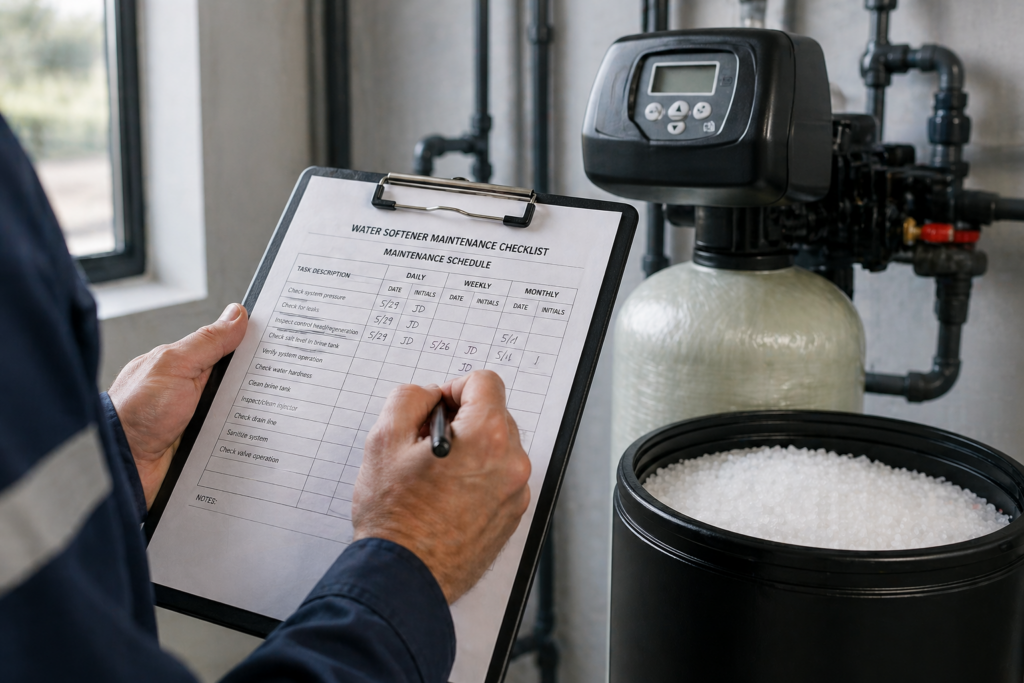
Annual overhauls cover full system line disinfection and post-disinfection microbiological testing, RO membrane replacement assessment, softener resin testing, pressure vessel inspection, control panel calibration, UV lamp replacement, dosing programme review, and a complete review of the Legionella risk assessment and water system schematic drawings.
Chemical Dosing: Maintenance, Calibration and Compliance
Chemical dosing systems are among the most critical and frequently under-maintained components of commercial water treatment in Saudi Arabia. The Kingdom’s desalinated water supply, while low in hardness, is naturally aggressive and corrosive without appropriate chemical conditioning. In areas served by groundwater or blended supplies, high TDS and hardness levels require robust scale inhibition programmes. In both cases, dosing pump accuracy is not a marginal consideration: a pump under-delivering by 20% will progressively under-treat the system with no visible early warning.
The most common dosing applications for commercial water systems in KSA include corrosion inhibitors for desalinated water conditioning and closed circuit treatment, scale inhibitors (polyphosphate or phosphonate) for hard water and RO pre-treatment applications, biocides for cooling tower and Legionella control programmes, pH correction chemicals for RO pre-treatment and boiler feedwater, and sodium hypochlorite for storage tank and distribution system chlorination.
The maintenance programme for dosing systems must include daily operational verification of each pump, weekly injection rate checks against calibrated set points, monthly calibration against a known volume with injection point inspection, quarterly pump head and diaphragm overhaul, and an annual full programme review against current water chemistry data. All chemical handling must be governed by a current hazardous substances risk assessment covering appropriate controls, personal protective equipment, storage, secondary containment, and emergency procedures. Sovereign Water includes chemical handling documentation review and compliance guidance as part of our annual KSA Comprehensive Maintenance service visits.
Annual System Line Disinfection and Testing
Periodic system line disinfection is a common element of commercial water system maintenance programmes in Saudi Arabia. It involves the chemical disinfection of all pipework, storage vessels, and distribution infrastructure to eliminate biofilm, flush accumulated sediment, and confirm the microbiological safety of the system. In Saudi Arabia’s high-temperature environment, where ambient conditions accelerate biofilm development in storage tanks and dead legs, this annual intervention is particularly important.
A typical procedure involves introducing a disinfectant such as sodium hypochlorite at the concentration and contact time set out in the site's written disinfection method, reaching all sections including branches and dead legs, followed by thorough flushing and post-disinfection microbiological testing before the system is returned to service.
Additional disinfection beyond the annual programme is required following any positive Legionella result above the action threshold, significant remedial works on the water system infrastructure, extended shutdown, commissioning of new systems or extensions, or any unexplained deterioration in microbiological water quality. Post-disinfection testing must be conducted by an accredited laboratory and results retained as part of the site’s permanent water treatment records. No system should be returned to service following disinfection without confirmed satisfactory post-disinfection test results.
Legionella Monitoring, Sampling and International Best Practice
Legionella risk management is one of the most important and often underestimated responsibilities for commercial building operators in Saudi Arabia. The Kingdom’s extreme ambient temperatures create conditions that are more challenging for Legionella control than in temperate climates: outdoor temperatures regularly exceeding 45°C in summer place significant pressure on cold water storage and distribution systems, making it difficult to maintain the below-20°C cold water temperatures that prevent Legionella proliferation, and creating elevated risk in any sections of the system where stagnation, dead legs, or inadequate insulation allow temperatures to rise into the Legionella growth range of 20°C to 45°C.
Many international building operators in the Kingdom use the UK Health and Safety Executive’s Approved Code of Practice L8 and supporting HSG274 technical guidance as a best-practice framework for Legionella control. This framework requires a current, site-specific Legionella risk assessment identifying all water systems, assessing the conditions within them that might support Legionella growth, and specifying appropriate control measures and monitoring frequencies. L8 says the risk assessment should be reviewed regularly, and whenever there is reason to think it is no longer valid, for example after a significant change to the water system or building use.
Temperature monitoring is the primary ongoing control measure. Hot water storage must reach and maintain a minimum of 60°C. Hot water distribution must deliver water at 50°C or above (55°C in healthcare premises) at sentinel outlets within one minute of running. Cold water should be below 20°C, with sentinel outlets reaching below 20°C within two minutes of running. In Saudi Arabia’s climate, achieving and maintaining cold water below 20°C requires particular attention to tank insulation, chilled water distribution where necessary, and regular temperature verification. Temperature checks at defined sentinel outlets must be conducted and recorded monthly. A full system temperature survey must be conducted at least annually.
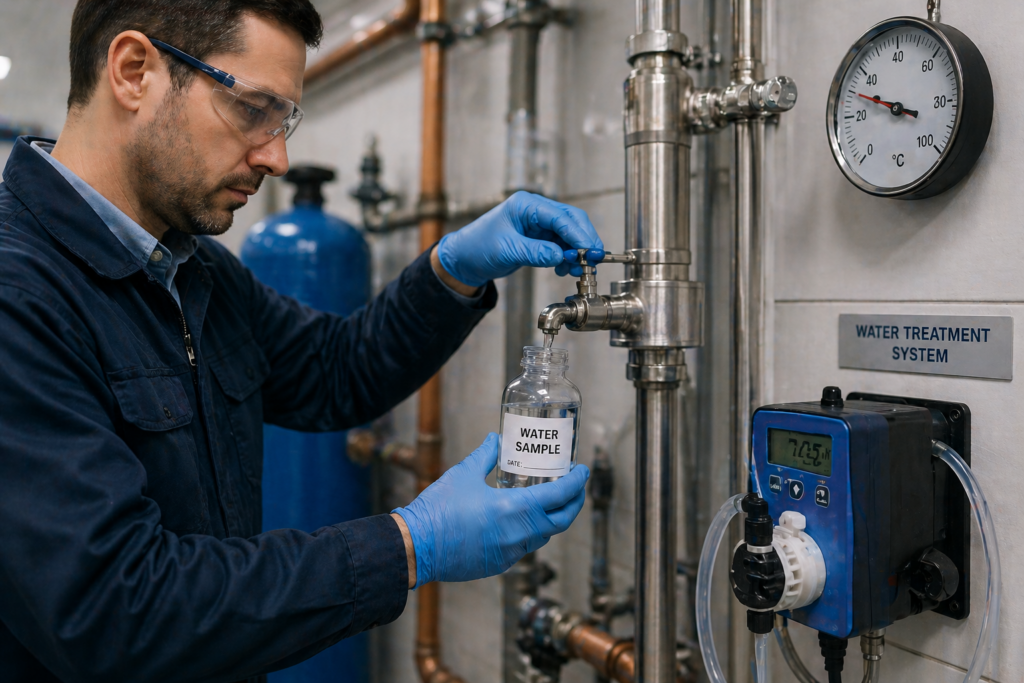
Legionella microbiological sampling from defined sample points (cold water storage tanks, hot water calorifiers, sentinel outlets, and any spray-generating equipment) should follow the frequency set by the risk assessment, with routine sampling for cooling towers and evaporative condensers where present. All samples must be tested by an accredited laboratory using ISO 11731 methodology. Under HSG274, results above 100 colony forming units per litre (cfu/l) call for resampling and a review of control measures, and results above 1,000 cfu/l call for an immediate review and remedial action, which may include disinfection.
L8 says records of monitoring, inspections, tests and checks should be kept for at least five years, and the risk assessment records while current and for at least two years afterwards. All records should be available for review by building owners, tenants, and relevant authorities on request. A designated competent Responsible Person must be identified for each site, with appropriate training and authority to ensure all control measures are maintained.
Comprehensive Maintenance vs Reactive Maintenance
The cost case for preventive water treatment maintenance over a reactive approach is compelling in any market, but it is particularly strong in Saudi Arabia, where the combination of extreme operating conditions, the complexity of large commercial water systems, and the challenges of sourcing emergency technical support for specialist equipment make reactive failures disproportionately costly and disruptive.
Reactive maintenance fails in multiple ways simultaneously. A failed water softener delivering hard water to a hotel’s steam equipment or a hospital’s sterilisation systems causes scale damage that begins immediately and compounds daily. A dosing pump losing calibration allows corrosion to progress in closed circuit pipework without any visible sign for months. A Legionella temperature exceedance that goes undetected because no monitoring programme is in place creates liability that no reactive response can undo. The cost of properly documented preventive maintenance is consistently and significantly lower than the combined cost of reactive repairs, equipment replacement, and compliance exposure.
Comprehensive Maintenance goes further than conventional preventive maintenance by using real-time performance data to optimise the timing and scope of interventions. Rather than servicing equipment on fixed calendar dates regardless of condition, Comprehensive Maintenance flags developing issues (rising filter pressure differential, declining dosing pump output, approaching filter capacity, sentinel temperature exceedance) before they become failures. This reduces unnecessary service visits whilst ensuring that genuinely critical interventions are never delayed.
How to Build Your Water Treatment Maintenance Schedule
Building an effective water treatment maintenance schedule for a Saudi commercial site begins with a professional water quality assessment and system survey. This establishes baseline water chemistry parameters (TDS, hardness, pH, chlorine, and where relevant, microbiological indicators), identifies the specific treatment challenges of the incoming supply, confirms whether existing systems are correctly specified for site conditions, and establishes whether a current Legionella risk assessment is in place and up to date.
The schedule is then built around the tiered frequency model described in this guide, with every task assigned a responsible party, completion timeframe, and documentation requirement. Escalation criteria must be defined: the specific conditions (temperature exceedance, out-of-specification water quality result, positive Legionella sample, dosing pump fault) that trigger an immediate intervention rather than waiting for the next scheduled visit.
For multi-site operators across Saudi Arabia (commercial property portfolios, hotel groups, healthcare networks, retail and hospitality chains), a standardised maintenance schedule across all locations delivers both compliance consistency and cost efficiency. Sovereign Water manages multi-site water treatment maintenance programmes across the Kingdom under single service agreements, providing consistent technical standards, unified documentation, and a single point of contact. Contact our team to discuss your KSA requirements.
How Sovereign Water’s Comprehensive Maintenance Works in KSA
Sovereign Water delivers commercial water treatment solutions across Saudi Arabia and the wider GCC, with a deep understanding of the specific water quality challenges, regulatory expectations, and operational requirements of the Kingdom’s commercial market. Our Comprehensive Maintenance programme provides fully managed water treatment maintenance for KSA commercial clients, removing the burden of schedule management, consumable procurement, chemical handling compliance, Legionella monitoring, and documentation from in-house facilities teams.
Every Comprehensive Maintenance engagement in Saudi Arabia begins with a site assessment: a comprehensive survey of existing water treatment systems, review of maintenance records and risk assessments, and identification of any compliance or performance gaps. From this assessment, we build a bespoke maintenance schedule specifying correct service intervals for every system component, integrating chemical dosing management, Legionella monitoring, annual line disinfection, and full compliance documentation into a single coordinated programme.
On an ongoing basis, our KSA Comprehensive Maintenance contracts cover all scheduled service visits, filter and consumable replacements, chemical dosing calibration and compliance documentation, Legionella temperature monitoring and sampling coordination, annual system disinfection, and responsive technical support between visits. To find out how our Comprehensive Maintenance programme can be structured for your KSA site or portfolio, contact our team today.
Frequently Asked Questions
How often should commercial water treatment systems be serviced in Saudi Arabia?
Most commercial systems in KSA need daily operational checks, monthly water quality testing and Legionella sentinel temperature monitoring, quarterly equipment servicing, microbiological sampling at the frequency set by the risk assessment, and a full annual overhaul. Saudi Arabia’s extreme ambient temperatures make cold water temperature control and storage tank inspection particularly important components of the quarterly and annual programme.
Why is Legionella monitoring more challenging in Saudi Arabia than in cooler climates?
Ambient temperatures regularly exceeding 45°C in summer place significant pressure on cold water storage and distribution systems, making it harder to maintain the below-20°C cold water temperatures required to prevent Legionella growth. Dead legs, inadequately insulated pipework, and infrequently used outlets are particularly high-risk in the Kingdom’s climate, requiring more vigilant monitoring and potentially higher sampling frequencies than in temperate markets.
What chemical dosing is typically required for commercial water systems in KSA?
The most common applications include corrosion inhibitors for desalinated water conditioning and closed circuit treatment, scale inhibitors for hard water or RO pre-treatment, biocides for cooling tower Legionella control, pH correction for RO and boiler feedwater, and sodium hypochlorite for storage tank and distribution system chlorination. The specific dosing programme should be determined by a professional water quality assessment of the incoming supply.
What international standards apply to water treatment maintenance in Saudi Arabia?
Many international operators in KSA use the WHO Guidelines for Drinking-water Quality, and the UK HSE Approved Code of Practice L8 and HSG274 as a best-practice framework for Legionella control. Sovereign Water helps clients implement and maintain these standards across their Saudi Arabia operations.
How does Sovereign Water support water treatment compliance in KSA?
Sovereign Water provides fully managed Comprehensive Maintenance contracts in Saudi Arabia covering all scheduled servicing, chemical dosing management, Legionella monitoring and sampling coordination, annual system disinfection, and complete compliance documentation. We manage the entire programme on the client’s behalf with a single point of contact across single or multiple KSA sites.
Ready to Put a Proper Maintenance Schedule in Place Across Your KSA Sites?
Sovereign Water builds and manages bespoke water treatment maintenance schedules for commercial businesses across Saudi Arabia. From site assessments to fully managed Comprehensive Maintenance contracts covering chemical dosing, Legionella monitoring, annual disinfection, and compliance documentation, we take the complexity out of water system management in the Kingdom.
Sources
- UK HSE, Approved Code of Practice L8: https://www.hse.gov.uk/pubns/books/l8.htm
- UK HSE, HSG274 Part 2, hot and cold water systems: https://www.hse.gov.uk/pubns/priced/hsg274part2.pdf
- UK HSE, What is Legionella (growth 20 to 45°C): https://www.hse.gov.uk/legionnaires/what-is.htm