

For businesses operating in Saudi Arabia, access to clean, chilled drinking water is not simply a workplace convenience, it is an operational necessity. With summer temperatures that can exceed 45°C in cities such as Riyadh, Jeddah, and Al Khobar, hydration directly affects employee health, productivity, and wellbeing. Whether you are setting up a new office, reviewing an existing water cooler contract, or considering whether to rent or purchase outright, understanding the true cost of water cooler rental in Saudi Arabia in 2026 is essential before committing to any agreement. This guide sets out the full picture, clearly and without the sales jargon. You can also explore Sovereign Water’s full range of water dispensers to see what a quality mains-fed solution looks like for the Saudi market.
The GCC water dispenser market has expanded considerably in recent years, driven by a growing commercial sector, large-scale infrastructure development under Vision 2030, and increasing awareness of workplace health and sustainability standards. IMARC Group values the global water cooler market at USD 3.0 billion in 2025 and expects it to reach USD 4.7 billion by 2034. This growth has also brought with it a more complex rental marketplace, where headline prices do not always reflect the full cost of a contract. This article breaks down what water cooler rental actually costs in Saudi Arabia, what should be included, the charges businesses are often caught out by, and whether renting is the right choice for your organisation.
In This Article
- How Much Does Water Cooler Rental Cost in Saudi Arabia?
- What Is Typically Included in a Rental Package?
- Mains-Fed vs Bottled Water Cooler Rental Costs
- Hidden Costs to Watch Out For
- Buying vs Renting: The True Cost Comparison
- Choosing the Right Water Cooler for Your Business
- Frequently Asked Questions
How Much Does Water Cooler Rental Cost in Saudi Arabia?
Rental pricing for water coolers in Saudi Arabia varies depending on the type of machine, the supplier, and the level of service included in the contract. Basic bottled coolers usually cost the least to rent each month, while mains-fed point-of-use models with hot and chilled water cost more. Any quoted monthly fee normally covers the rental of the equipment itself and should be treated as a starting point rather than a total cost.
Rental pricing structures differ considerably between suppliers in the Saudi market. Some operate on short-term rolling agreements with higher monthly fees, whilst others offer lower rates in exchange for minimum contract commitments of one, two, or three years. Before signing any agreement, it is worth calculating the total cost over the full contract term rather than focusing solely on the monthly figure. A contract that appears cost-effective on a month-by-month basis can prove expensive if it includes long notice periods, automatic renewal clauses, or significant early termination fees.
For larger organisations with offices across multiple floors or sites in cities such as Riyadh, Jeddah, and Dammam, volume pricing is often available. Suppliers are generally prepared to negotiate when a business is committing to multiple units, so it is always worth asking for a consolidated proposal. Equally, businesses that have been with the same rental provider for a number of years may find that switching suppliers or renegotiating at renewal delivers meaningful cost savings.
What Is Typically Included in a Rental Package?
The best rental agreements in Saudi Arabia bundle delivery, installation, and ongoing maintenance into a single monthly fee, making budgeting straightforward and removing the need for separate service contracts. Understanding what a comprehensive package should include helps you identify genuine value from an artificially low headline price.
A well-structured rental package should include delivery and professional installation, routine servicing at least every six months, filter changes on schedule, and the repair or replacement of faulty units within the monthly fee. In the Saudi climate, where machines work harder due to higher ambient temperatures and elevated water consumption, regular servicing is particularly important to maintain consistent performance. Sanitisation should also be included as a standard part of any contract, as good hygiene practice for any drinking-water point.
Customer support response time is worth scrutinising before signing. In a market where temperatures can make access to chilled water a genuine health consideration, a supplier that cannot respond to a faulty machine within 24 to 48 hours is not meeting an acceptable standard of service. Ask specifically whether emergency callouts are included within the contract fee or charged separately, and request confirmation of guaranteed response times in writing.
Mains-Fed vs Bottled Water Cooler Rental Costs
One of the most consequential decisions when selecting a water cooler for a Saudi business is whether to opt for a mains-fed (point-of-use) system or a traditional bottled water cooler. The two models operate differently, carry distinct cost structures, and suit different workplace environments. Understanding this distinction is essential to making a sound financial comparison for the Saudi context.
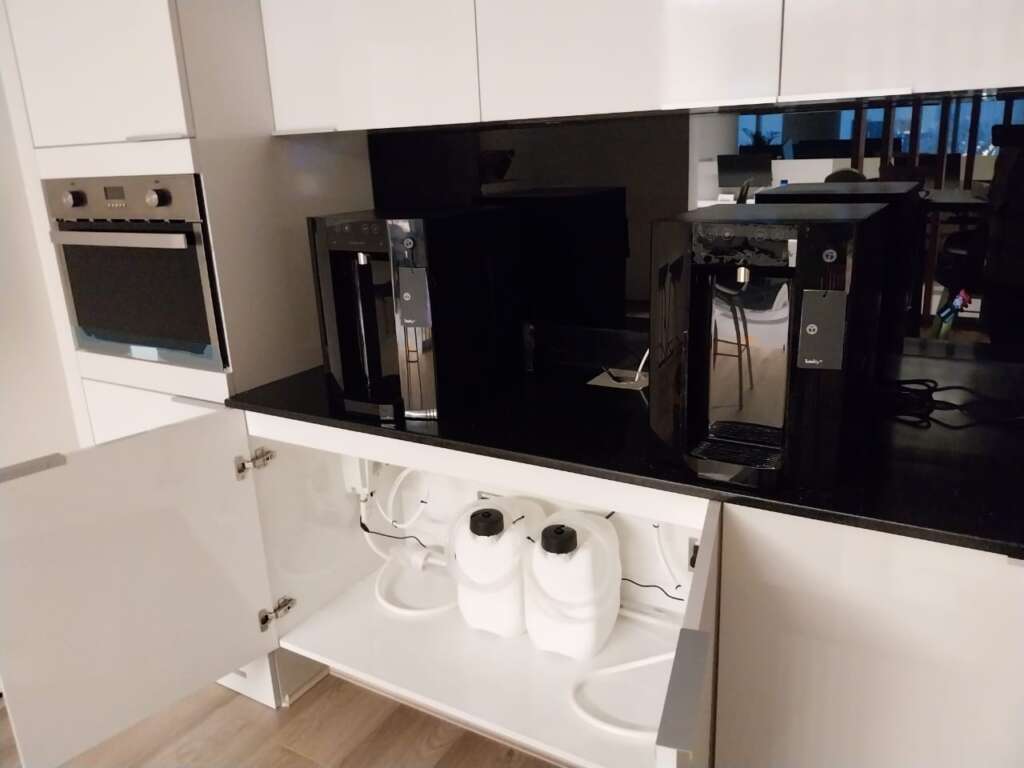
Mains-fed water coolers connect directly to your building’s water supply and pass the water through a filtration system before delivering chilled, ambient, or hot water on demand. There are no bottle deliveries to manage, no storage requirements, and no risk of supply running out during a busy workday. For Saudi offices that operate long hours and serve large numbers of staff, the operational simplicity of a mains-fed system is a significant practical advantage. The water produced is consistently filtered and generally of higher quality than large bottled alternatives that have been stored in warm conditions prior to delivery.
Bottled water coolers rely on large water containers delivered and changed on a regular schedule. The rental fee for the equipment itself may appear lower initially, but the ongoing cost of water deliveries adds considerably to the total outlay. For a busy office in Riyadh or Jeddah, the monthly spend on bottles alone can exceed the rental fee for the machine. For offices with limited storage space or those seeking to reduce their environmental footprint as part of a corporate sustainability or Vision 2030 aligned strategy, the logistical and reputational case for mains-fed is compelling.
When comparing costs over a full year, most Saudi businesses with access to a suitable mains connection find that a point-of-use system offers better value, greater operational convenience, and a smaller environmental impact. The elimination of single-use plastic bottle waste is also directly relevant to organisations with ESG reporting commitments or those aligning with Vision 2030 environmental targets. Sovereign Water’s team can assist with a site assessment and cost comparison for your specific site.
Intel Market Research notes that modern workplaces increasingly favour bottleless water coolers integrated with building water systems.
Hidden Costs to Watch Out For
The water cooler rental market in Saudi Arabia, as in other markets, carries a number of costs that are not always highlighted in initial quotations. Understanding these in advance places you in a stronger negotiating position and helps avoid budget surprises once a contract is active.
Installation charges are a common area of ambiguity. Some suppliers include professional installation within the rental fee; others treat it as a one-off charge invoiced separately. If your premises require plumbing modifications to connect a mains-fed unit, this may involve additional cost from a certified contractor. Always request a written breakdown of all one-off charges before agreeing to a contract, and confirm whether VAT (15% in Saudi Arabia since 1 July 2020) is included or excluded from the quoted figures.
Minimum contract terms and early termination fees can lock businesses in unexpectedly. Some suppliers in the Saudi market operate on 24 or 36-month minimum terms with financial penalties for early exit. If your business is expanding, planning a relocation, or otherwise likely to change premises during the contract period, a shorter rolling arrangement may be preferable even if the monthly rate is slightly higher.
Out-of-contract repairs and consumable charges are another area to scrutinise. If a machine breaks down and the fault is deemed to fall outside the scope of the service agreement, a callout charge and parts cost may apply. Filter replacements, drip trays, and similar consumables are sometimes charged separately rather than included in the monthly fee. For bottled cooler arrangements, delivery fees, bottle deposits, and collection charges for empties all add to the running total and should be requested in writing before signing.
Finally, price escalation clauses allow suppliers to increase the monthly rental fee over time, often linked to CPI or at the supplier’s discretion. Always check for these clauses and, where possible, negotiate a fixed price for the initial contract term. Reputable suppliers will be transparent about their pricing structure from the outset.
Buying vs Renting: The True Cost Comparison
For many Saudi businesses, renting a water cooler feels like the natural, low-risk option. There is no large upfront investment, maintenance is managed by the supplier, and the arrangement can theoretically be ended when no longer needed. These are genuine advantages. However, for businesses with stable, long-term requirements, purchasing a water cooler outright or through a financing arrangement can prove considerably more cost-effective over a three to five-year horizon.
As a simple worked example, a monthly rental of SAR 190 adds up to SAR 6,840 over a three-year term in rental fees alone, before any out-of-contract charges. A business that purchased a comparable machine outright and arranged a separate maintenance contract, which typically costs less than an all-inclusive rental, may find the three-year total cost substantially lower. Over five years, the financial case for ownership becomes even stronger.
The simplicity of a single monthly invoice has genuine appeal, particularly for finance teams managing multiple supplier relationships. For businesses with tight cash flow or those that prefer to preserve capital for core operations, the rental model remains a reasonable choice. However, it is always worth requesting a total cost of ownership comparison before committing. Sovereign Water provides this analysis as part of its consultation process, helping businesses make the decision that genuinely suits their situation.
Businesses currently renting from large national or regional providers should also consider whether they are paying a premium for the brand name rather than superior service or product quality. Independent specialist suppliers can often provide equivalent or superior equipment and support at a more competitive price, with greater flexibility and more direct account management. You can explore Sovereign Water’s Comprehensive Maintenance programme for an example of what proactive, transparent support looks like in practice.
Choosing the Right Water Cooler for Your Saudi Business
Once you have a clear understanding of the costs involved, the next step is identifying which water cooler is the right fit for your specific workplace. The choice depends on several factors: the number of people the machine will serve, whether your premises have a suitable mains connection, the importance of sustainability to your organisation, and what temperature options you require.
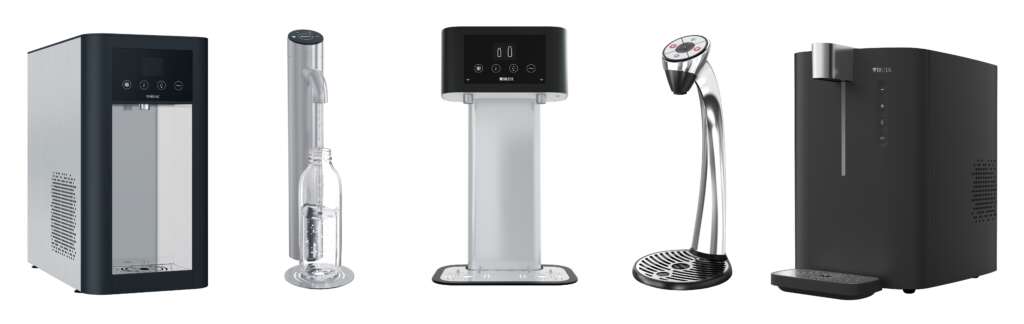
For smaller offices of up to 20 staff, a countertop mains-fed unit or a compact bottled cooler is typically sufficient. These models occupy minimal space and provide a reliable supply of chilled water throughout the day. For medium to large offices, floor-standing mains-fed dispensers with both chilled and ambient options offer greater capacity without the logistical burden of bottle management. For high-demand environments such as large corporate offices, hotels, or healthcare facilities, premium units from brands such as ZIP HydroTap or BRITA VIVREAU deliver boiling, chilled, and sparkling water from a single point, significantly reducing the need for separate kettles and improving energy efficiency.
Water quality in Saudi Arabia varies by region and source, with hardness levels and mineral content differing between municipal supplies in Riyadh, Jeddah, Al Khobar, and other cities. Desalinated water, which is the primary source for much of the Kingdom, carries its own treatment requirements. A supplier that assesses your specific water quality before recommending equipment will deliver a better outcome than one that applies a one-size-fits-all specification. Sovereign Water specifies for your supply on every engagement to ensure the solution provided is genuinely fit for purpose in your specific location and application.
Frequently Asked Questions
How much does it cost to rent a water cooler in Saudi Arabia?
Rental costs in Saudi Arabia depend on the machine specification, whether it is bottled or mains-fed, and the services included in the contract. Always request a full written breakdown of all costs, including VAT at 15%, before signing any agreement.
Is it cheaper to rent or buy a water cooler in Saudi Arabia?
Over the short term, renting involves no upfront capital cost and is generally the lower-risk option. Over three to five years, purchasing a machine and maintaining it separately often proves more cost-effective. The right answer depends on your cash flow, the stability of your premises, and how long you expect to require the equipment. Sovereign Water can provide a total cost of ownership comparison on request.
What should be included in a water cooler rental agreement?
A comprehensive agreement should include delivery, professional installation, regular servicing (at least every six months), filter changes, sanitisation visits, and repair or replacement of faulty units, all within the monthly fee. Confirm whether VAT is included in quoted prices and ask for response time commitments in writing.
What is the difference between a mains-fed and a bottled water cooler?
A mains-fed unit connects directly to your building’s water supply and filters the water on demand, with no bottle deliveries required. A bottled cooler relies on large containers delivered periodically. In the Saudi climate, mains-fed systems are generally more cost-effective, more convenient, and better suited to high-consumption environments.
Are there specific water quality standards I should be aware of in Saudi Arabia?
Yes. The Ministry of Environment, Water and Agriculture (MEWA) sets guideline values for drinking water, and much of the Kingdom's supply is desalinated water delivered by the Saudi Water Authority. Point-of-use filtration can improve taste and protect equipment. Sovereign Water specifies for your supply to ensure any dispenser or treatment system specified is correctly matched to your local supply.
Ready to Find the Right Water Solution for Your Saudi Business?
Sovereign Water provides expert advice on water dispensers and mains-fed coolers for businesses across Saudi Arabia, with a team that understands the specific demands of the Kingdom’s climate, water quality, and commercial environment.
Sources
- IMARC Group, Water Cooler Market Report: https://www.imarcgroup.com/water-cooler-market
- Intel Market Research, Water Coolers Market Outlook 2026-2034: https://www.intelmarketresearch.com/water-coolers-market-30081
- PwC Worldwide Tax Summaries, Saudi Arabia other taxes (VAT 15% from 1 July 2020): https://taxsummaries.pwc.com/saudi-arabia/corporate/other-taxes
- Al-Hamzah and Fellows, Drinking Water Quality in the Kingdom of Saudi Arabia, Water 2024: https://www.swcc.gov.sa/uploads/water-16-01810%20(3).pdf