

Choosing an Everpure Fibredyne FC system in Saudi Arabia starts with one question: where does your water come from? A café in Riyadh, a hotel in Jeddah and a QSR in Dammam can all buy the same cartridge, but they should not all run it the same way. The water source, the rooftop tank and the season change how long a cartridge lasts and what has to sit in front of it.
This guide is written for Saudi operators. It covers how the FC range behaves in each main region, why summer heat and peak-season demand matter, and how to size a system so it does not run out mid-service. As an authorised Everpure distributor for KSA and the GCC, Sovereign Water supplies, installs and maintains the range through our Comprehensive Maintenance programme.
Quick answers
- An FC cartridge pairs bacteriostatic Fibredyne media with a built-in scale inhibitor. It is a filter and scale-control stage, not a desalination stage.
- Capacities run from 6,000 to 100,000 gallons and flow from 1.5 to 10 gallons per minute (gpm), so you can match a single espresso machine or a whole hotel floor.
- Where incoming water is high in dissolved solids, FC works best behind upstream pre-treatment that we design per site.
- Summer storage-tank temperatures and Hajj and Umrah demand peaks are the two things most often missed when sizing in the Kingdom.
What an FC system actually does
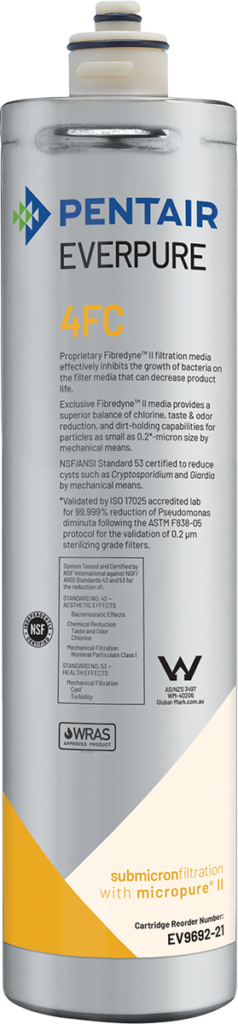
An FC cartridge sits on the cold line feeding your coffee machine, ice maker or beverage station. It does three jobs. It reduces chlorine taste and odour. It filters fine particles (Pentair lists 5 micron and 0.2 micron models). And its integrated inhibitor helps limit scale and corrosion on heating elements and evaporator plates.
"All models feature Fibredyne bacteriostatic media that reduce chlorine taste and odors and include an integrated scale inhibitor to minimize scale and corrosion to extend equipment life." Pentair Commercial Filtration
What it does not do is remove dissolved salts. If your supply is high in dissolved solids, a filter alone will not change the taste profile of coffee or the clarity of ice. That is a job for pre-treatment or reverse osmosis, which is why site assessment comes first.
Three Saudi water situations
Riyadh and the central region. Supply here includes groundwater and blended sources, and review work on Saline Water Conversion Corporation (SWCC) data shows the groundwater feeding Riyadh runs well above the 400 ppm TDS guideline used for newer transmission lines. The Ministry of Environment, Water and Agriculture (MEWA) guideline allows up to 1,000 ppm TDS in drinking water. For a Riyadh café, expect to pair FC with a softener or scale-prevention stage, and plan on shorter cartridge intervals than the brochure's headline gallons.
Jeddah, Makkah and the Red Sea coast. Supply leans on desalinated seawater. Dissolved solids are usually lower than inland groundwater, but chloride is a concern for stainless steel and boilers over the long term. FC copes well with taste and scale control here, and many Jeddah sites run it directly on cold lines with a periodic water analysis to confirm.
Dammam, Jubail and the Eastern Province. Gulf-sourced desalinated supply and industrial neighbours mean we always test before specifying. Sites here are the most likely to need bespoke pre-treatment ahead of the cartridge.
These are starting assumptions, not a substitute for a test. Rooftop and basement tanks in the same city can deliver very different water to two neighbouring units.
Why summer heat changes the specification
Saudi summers push ambient temperatures in plant rooms and rooftop tanks well above the conditions most manuals assume. Warm stored water is a food-safety concern for ice and beverage service, and it is one reason the bacteriostatic media matters. It does not replace tank hygiene or a Legionella risk assessment, but it protects the cartridge itself.
Practical points we apply on Saudi sites:
- Mount cartridges away from direct sun and hot plant-room walls.
- Fit an inlet shut-off and flush valve so every cartridge change is clean and quick.
- Check lines and fittings for heat exposure, because warm water is the usual cause of early taste complaints.
Sizing for Hajj, Umrah and event peaks
Hotels and restaurants in Makkah and Madinah, and venues in Riyadh during major events, see throughput that is several times their quiet-season average. A cartridge sized to the average will run out in the busiest week. Size to peak flow, not annual average, and consider a twin or triple manifold such as the QC7I so a second cartridge carries the load while the first is swapped.
For high-volume ice, Pentair rates the QC7I single 4FC5-S at 15,000 gallons. Twin configurations add capacity and flow for several Hoshizaki, Manitowoc or Scotsman machines on one line.
Coffee: what the specialty scene needs
Saudi Arabia's specialty coffee market is growing quickly, and extraction depends on stable water chemistry. Operators with La Marzocco, Victoria Arduino, Sanremo or Slayer machines usually specify an FC head with a 4FC5 or larger cartridge. La Marzocco names water outside its specifications as the most common cause of machine failure, and its warranty guidance makes water quality your responsibility.
Where incoming water is high in solids, an FC cartridge alone may not hit the Specialty Coffee Association's target range. In that case we blend or pre-treat so the water entering the cartridge is already conditioned. See our wider commercial water treatment capability.
Servicing across the Kingdom
Cartridge change is a sanitary quick-change: the spent unit unscrews and a new one goes in without exposing the system internals. Intervals depend on cartridge gallon rating, real throughput and incoming water analysis. Comprehensive Maintenance schedules changes against actual usage so a cartridge is never exhausted in the middle of service. We cover Riyadh, Jeddah, Makkah, Madinah, Dammam, the Eastern Province and Red Sea giga-project sites.
Frequently asked questions
Can I run an FC cartridge directly on Saudi mains water?
Sometimes, depending on city and building. Moderate hardness is handled by the integrated inhibitor. High-solids supply is better treated upstream first. A water analysis tells you which.
Does FC remove salt from the water?
No. It filters, removes chlorine taste and helps control scale. Dissolved salts need pre-treatment or reverse osmosis.
How often will I change cartridges?
It depends on gallon rating, throughput and water quality. In high-TDS locations the interval is shorter than the brochure figure unless pre-treatment is fitted. We schedule changes from usage data.
Can one system feed several machines?
Yes. Twin, triple and quad manifolds supply several coffee, ice and beverage units. We size on combined peak flow so no machine loses pressure when they run together.
Is Sovereign Water an authorised Everpure distributor in KSA?
Yes, for Saudi Arabia and the wider GCC. We supply genuine cartridges and heads, install with qualified engineers and provide full maintenance support.
Specify your FC system with an engineer
Tell us your city, equipment and daily throughput and we will recommend the cartridge, manifold and pre-treatment for your site. Talk to our team.
Sources
- Pentair, Everpure High-Performance FC Systems for Coffee and Ice Applications
- Pentair Everpure, FC Family Brochure
- Al-Hamzah and Fellows, Drinking Water Quality in the Kingdom of Saudi Arabia, Water 2024, 16, 1810
- La Marzocco, Warranty