

Facilities managers in Riyadh, Jeddah and Dammam who want one drinks point to replace a kettle, a bottled water cooler and a crate of sparkling water usually end up looking at the BRITA Extra C-Tap. It is an under-sink unit with a single designer tap on the worktop that pours hot, room-temperature, cold, lightly fizzy and fully sparkling water. In the Kingdom, though, the tap is the easy part. The real work is making sure the water reaching it, often desalinated, blended, then held in a ground tank and a rooftop tank, does not wear out the filters and boiler early. This guide explains what the Extra C-Tap does, how to size it, and how Sovereign Water plans the installation around Saudi supply conditions.
TL;DR
- One tap on the counter gives five drinks: still at room temperature, still chilled, chilled semi-sparkling, chilled sparkling and hot up to 95°C.
- BRITA rates it for roughly 20 to 100 regular users. Pick the medium boiler (20 L/h) or the large one (30 L/h) based on how many hot drinks are poured at once, not just headcount.
- BRITA filtration is built in: PURITY C on the hot line to limit scale, CLARITY Protect on the cold line down to 0.5 microns.
- Saudi buildings often store water in tanks before it reaches the pantry, and quality varies by city and by building. We look at the supply and storage at a chargeable site survey first, and add upstream treatment only where the site needs it.
- Sovereign Water handles specification, fitting, handover and planned servicing across the Kingdom.
Planning a new office floor or a pantry upgrade? Talk to our team with your headcount, location and drawings.
In This Article
- Who the Extra C-Tap Suits in Saudi Workplaces
- The Five Drinks on the Panel, and When Each Gets Used
- Specification Sheet at a Glance
- Running Cost, Standby Power and User Safety
- From Desalination Plant to Pantry: Planning for Saudi Feed Water
- A Practical Specification Checklist
- Survey, Fitting and Aftercare in the Kingdom
- Questions Saudi Facilities Teams Ask
Who the Extra C-Tap Suits in Saudi Workplaces
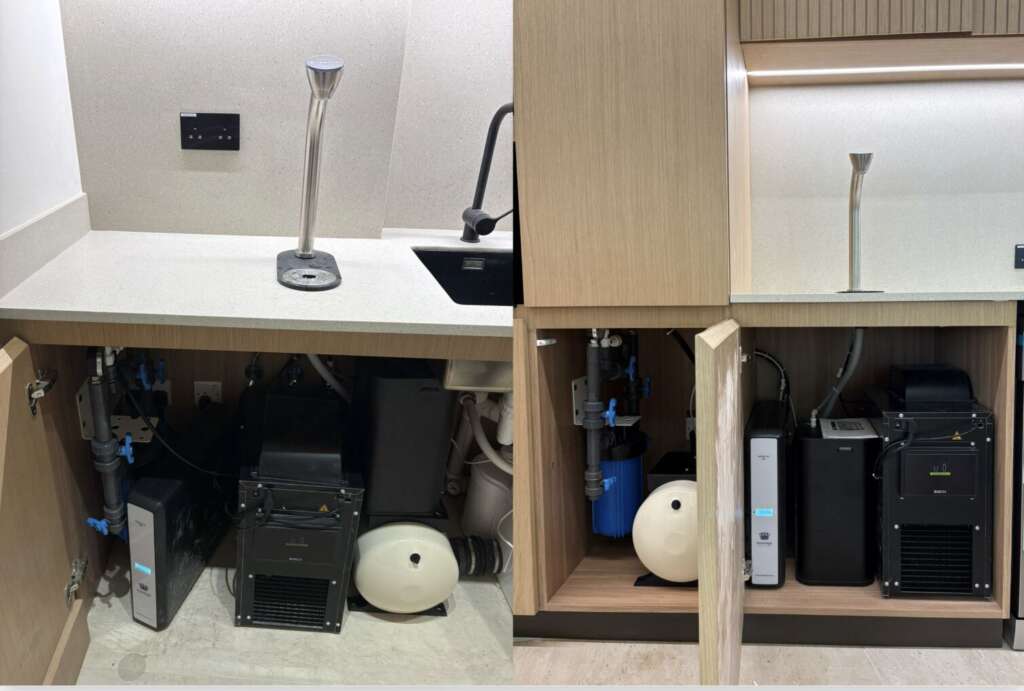
The Extra C-Tap is a mains-fed drinks system split into two parts. Above the counter sits a slim tap in brushed stainless steel with a glass touch panel. Below it, inside the cupboard, are the chiller, the boiler, the carbonator and the BRITA filter heads. Nothing bulky stands on the worktop, so the pantry stays clear and easy to wipe down.
That layout matters in the kinds of buildings we fit out across the Kingdom. In a King Abdullah Financial District tower in Riyadh, a pantry often doubles as a hospitality point for visiting clients, so appearance counts. In a Jeddah head office or an Al Khobar engineering firm, the priority is usually throughput at shift change and lunchtime. On large giga-project site offices and new-build campuses, the brief tends to be "remove bottled water deliveries entirely". The Extra C-Tap covers all three because one fixture handles hot drinks, chilled still water and sparkling.
BRITA positions the unit for teams of about 20 to 100 people, with the exact figure depending on the boiler chosen and how hard the hot side is worked. Typical Saudi settings include:
- Corporate and regional headquarters, including boardroom and executive floors
- Banks, insurers and professional services firms
- Ministries, authorities and semi-government offices
- Hospital and clinic administration areas (not clinical areas)
- Hotel back-of-house, staff canteens and serviced office lounges
If a site does not need hot water from the same tap, BRITA's Extra I-Tap covers chilled, ambient and sparkling only, and the Top Pro range offers countertop and floor-standing formats. For a broader comparison, see our commercial water dispenser range.
The Five Drinks on the Panel, and When Each Gets Used
Each option on the touch panel tends to earn its place at a different time of the working day. Thinking about who pours what, and when, is the quickest way to size the system correctly.
Hot, up to 95°C
The hot line serves tea, instant coffee, hot chocolate, herbal infusions and cup soups. In many Saudi offices, mid-morning and mid-afternoon tea rounds create sharp spikes, with several people filling cups or a teapot within a few minutes. BRITA fits an anti-scald feature on the hot dispense, which is worth pointing out at handover to new starters and cleaning staff.
Chilled still
From May to September this is the workhorse. When outside temperatures stay high for months, staff arriving from car parks and site visits want cold water in volume, and bottle refills climb. Pre-set portions on the panel let people fill a glass or a reusable bottle to a fixed amount without holding the button.
Room-temperature still
Many people prefer water that is not chilled, particularly with meals or when taking medication. Offering it from the same tap stops staff running the cold line to "warm it up", which wastes water and chiller capacity.
Semi-sparkling and sparkling
The carbonator under the counter produces two strengths of fizz from a CO2 cylinder. Sparkling on tap is popular in client-facing areas and at iftar gatherings during Ramadan, when offices often host evening events and demand moves later in the day. It also replaces the cases of bottled sparkling water that hospitality teams would otherwise store and chill.
BRITA describes the design as a designer tap and glass touch panel above the counter, with filter, carbonator, cooler and boiler hidden underneath. (BRITA Extra C-Tap product information)
Moving drinking water to a filtered mains supply cuts single-use bottles and delivery runs, which supports the environmental goals many Saudi organisations now report against under Vision 2030 and the Saudi Green Initiative.
Specification Sheet at a Glance
The figures below come from BRITA's published Extra C-Tap product information. They are the manufacturer's rated values; real-world output depends on feed water, inlet temperature and usage.
| Item | Medium boiler build | Large boiler build |
|---|---|---|
| Users BRITA rates it for | 20 to 100 regular users | 20 to 100 regular users |
| Hot water produced per hour | 20 L/h | 30 L/h |
| Hot water ready to pour before reheat | 1.8 L | 6 L |
| Hot flow at the spout | 1.6 L/min | 1.9 L/min |
| Hottest setting | up to 95°C | up to 95°C |
| Item | Value |
|---|---|
| Under-counter cooler size (W x H x D) | 272 x 490 x 473 mm |
| Cooler weight | 38.5 kg |
| Height of the tap | 330 mm |
| Hot-line filter | PURITY C Dispenser, sizes C300 to C1100, rated 2,784 L to 8,480 L at 10°dH carbonate hardness with 40% bypass |
| Cold-line filter | CLARITY Protect, nominal 11,500 L, particle reduction to 0.5 microns |
Options include the Easy Access Panel and automatic pre-set portions for glasses or bottles. Cupboard depth and ventilation are the two things most often missed on drawings, so we check both before an order is placed.
Medium or large boiler: sizing for Saudi demand peaks
The deciding question is not "how many staff?" but "how many hot drinks get poured in the busiest ten minutes?". The medium build suits a floor where tea is made a cup at a time. The large build holds 6 litres ready to pour, so it copes when someone fills a large teapot or a thermos flask or several people queue after a meeting. Sites that host frequent majlis-style visitor sessions, training days or Ramadan evening events usually justify the larger boiler. We size from observed or forecast peaks, not from the headcount on the lease.
Running Cost, Standby Power and User Safety
BRITA quotes about 2.24 kWh per day for the unit, based on 10 litres of hot and 60 litres of cold water drawn daily with standby included. Your own figure will move with usage and with how warm the incoming water is. In a Saudi summer, water arriving from a sun-exposed rooftop tank can be noticeably warm, which makes the chiller work harder, so the location of the storage tank is worth noting at survey.
On the filtration side, PURITY C reduces carbonate hardness before water reaches the boiler, which is what keeps scale under control on the hot line. CLARITY Protect on the cold line reduces particles to 0.5 microns, takes out chlorine taste and odour, and leaves the minerals in. Its particle reduction is rated to NSF/ANSI 42 Class I, which is an aesthetic standard covering taste, odour and particles.
BRITA states that its filtration gives good-tasting cold and hot water and prevents limescale. (BRITA Extra C-Tap product information)
Safety features worth listing in your risk register
BRITA lists four protections on the Extra C-Tap: leak detection, an emergency shut-off, anti-scald on the hot dispense and boiler sensors that detect overheating. Facilities teams working to ISO 14001 or ISO 45001, or recording equipment under SASO requirements for electrical products, can note these features in their equipment file and supplier due diligence.
From Desalination Plant to Pantry: Planning for Saudi Feed Water
Saudi Arabia is the world's largest producer of desalinated water, according to the Saudi Water Authority, with plants on both the Gulf and Red Sea coasts. Coastal cities draw heavily on that supply, while inland cities such as Riyadh receive water carried a long way from the coast and, in places, blended with groundwater. By the time it reaches an office pantry, the water has usually passed through a building's ground tank, a pump set and often a rooftop tank too.
Each of those steps can change what arrives at the tap:
- Blending. The mix of desalinated and well water can differ between districts and over time, so hardness and total dissolved solids (TDS) are not the same everywhere.
- Tank storage. Water sitting in tanks, especially rooftop tanks exposed to summer heat, can lose its chlorine residual, warm up and pick up sediment.
- Older risers and pipework. In established buildings, corrosion and debris add particles that load filters faster.
BRITA's standard cartridges are designed for typical mains conditions. Where TDS or hardness at a Saudi site is well above that, a PURITY C or CLARITY Protect cartridge working alone will run out sooner, taste can drift, and the boiler and carbonator take more wear.
What we do about it
Before we specify anything, a Sovereign Water engineer visits for a chargeable site survey. They look at how the building is supplied and how the water is stored, check the pantry and its services, and agree your busiest periods with you. What the survey finds decides the design:
- Water close to normal mains quality: the BRITA filters on their own, on a sensible change schedule.
- Hard water with moderate TDS: a commercial softener or extra sediment and carbon stages ahead of the dispenser.
- High TDS or persistent taste problems: a reverse osmosis stage with remineralisation, so the water is balanced again before it reaches the BRITA filters.
The aim is simple: steady taste at the tap, filter changes you can plan around, and a dispenser that lasts. It also means commissioning day goes smoothly rather than turning up a problem at the first service visit.
A Practical Specification Checklist
Use this list when briefing an architect, fit-out contractor or procurement team on a Saudi project:
- Number of regular users and the busiest hot-drink period of the day
- Whether hot, sparkling or both are needed (Extra C-Tap or Extra I-Tap)
- Cupboard width, depth and ventilation under the worktop
- Cold mains supply with an isolation valve, plus a drain point
- A dedicated electrical supply to the cupboard
- Where the building stores water: ground tank, rooftop tank or both
- Recent water readings if the landlord or FM provider has them
- Access for CO2 cylinder changes and filter swaps without moving fixed joinery
- Who on site will receive user training at handover
Survey, Fitting and Aftercare in the Kingdom
Sovereign Water supplies the BRITA Extra C-Tap in Saudi Arabia as part of a complete package rather than a box drop. A chargeable site survey comes first: we look at the supply and how it is stored, check services and space, and agree the busiest-period demand with you. From that, we confirm the boiler size, the tap position and any upstream treatment, and give you a written specification.
Our technicians then fit and commission the system, check that all five drinks dispense correctly, and walk reception, hospitality and facilities staff through daily use and basic cleaning. That handover matters more than it sounds: most service calls on new dispensers come from simple misuse rather than faults.
Mid-project and want a second opinion on a drawing? Talk to our team.
Planned servicing through Comprehensive Maintenance
After commissioning, the unit joins our Comprehensive Maintenance programme. Visits cover PURITY C and CLARITY Protect changes timed to actual usage, CO2 cylinder swaps, sanitisation and a performance check on each drink. You get one contact for every site, whether that is a single Riyadh floor or offices spread across Jeddah, Dammam and Riyadh. For client-facing pantries, planned visits avoid the awkward moment when the sparkling runs out in front of guests.
Comparing whole-life cost
When we quote, we set out the equipment, any upstream treatment, consumables and the service plan as separate lines. That lets finance and procurement compare the Extra C-Tap fairly against bottled water deliveries or an older hot-and-cold unit over the period they normally use for equipment decisions.
Questions Saudi Facilities Teams Ask
Is the Extra C-Tap big enough for a 60-person floor in Riyadh?
BRITA rates it for 20 to 100 regular users, so a 60-person floor is within range. If tea rounds are concentrated or the floor hosts visitors, choose the large boiler with 6 L ready to pour.
Can it run straight off the building supply without extra treatment?
Sometimes, but not always. It depends on TDS, hardness and how the building stores water. We assess this at the chargeable site survey and only add a softener, extra filtration or reverse osmosis where the site needs it.
Does a rooftop tank affect the dispenser?
It can. Rooftop tanks warm up in summer, which adds load to the chiller, and stored water can carry more sediment. We note tank arrangements at survey and allow for them in the filter plan.
How is scale kept out of the boiler?
PURITY C reduces carbonate hardness on the hot line, and any upstream treatment we specify takes the load off it further. Filter changes and sanitisation are part of the Comprehensive Maintenance visits.
What happens during Ramadan?
Daytime demand usually falls and evening use can rise if the office hosts iftar events. We can adjust service visits around your working pattern for the month.
Which water options does it offer?
Five: room-temperature still, chilled still, chilled semi-sparkling, chilled sparkling and hot up to 95°C, selected on a glass touch panel with pre-set portions for glasses or bottles.
Planning a Pantry or Tea Point in Saudi Arabia?
Tell us the site, the number of users, how the building stores its water and when your busiest periods are. We will come back with a specification for the Extra C-Tap and any treatment it needs, plus a service plan to match.
Sources
- BRITA, Extra C-Tap product information (users, boilers, draw-off, flow rates, dimensions, weights, tap height, 2.24 kWh/day, PURITY C and CLARITY Protect data): https://www.brita.co.uk/dam/jcr:a2b94e5e-aea7-475d-91dc-feaff082f379/brita-dispenser-extra-c-tap-productinformation-UK.pdf
- BRITA, Extra C-Tap product page (safety features, pre-set portions, filtration): https://www.brita.co.uk/water-dispensers/products/extra-c-tap
- NSF, NSF/ANSI 42 Drinking Water Treatment Units: Aesthetic Effects: https://www.nsf.org/standards-development/standards-portfolio/nsf-american-national-standards/nsf-ansi-42-drinking-water-treatment-units-aesthetic-effects
- Saudi Water Authority, desalination sector page (world's largest producer of desalinated water; plants on eastern and western coasts), accessed 3 October 2026: https://www.swa.gov.sa/en/related-sectors/swcc